Monday, 22 October 2012

I Love Rock 'n' Roll ...

... So put another dime in the jukebox baby ...

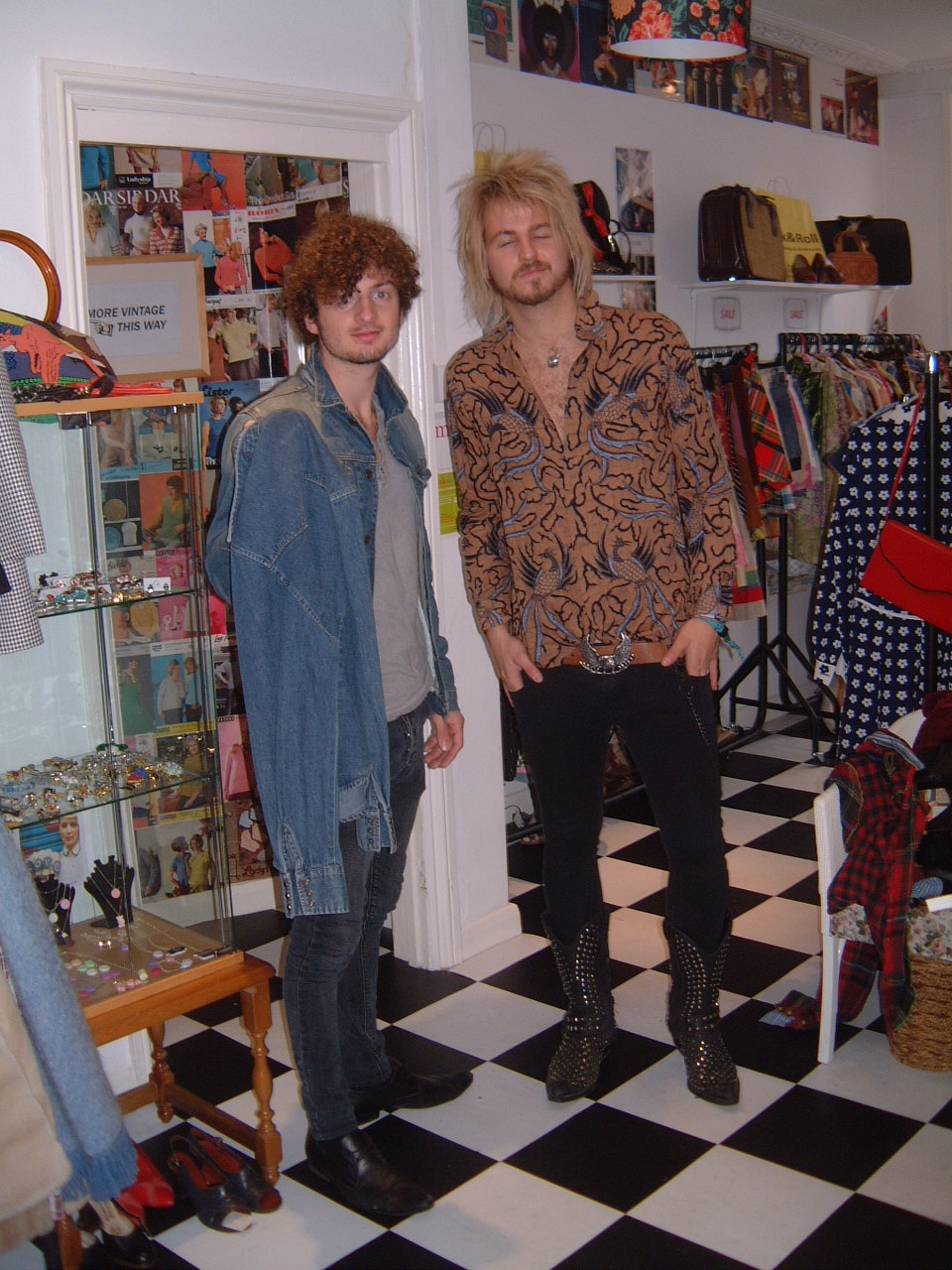
Frock&Roll were honoured the other day because the shop was graced by actual, real-life Reading rock royalty. Yep, Ashby and Liam from local band Private Jet came in to stock up on their stage wardrobes. The Private Jet guys are regulars in the shop and we thought we’d introduce you and wave a flag for roooaaarrr talent from our very own 'Ding.


After perusing through women’s blouses (on the rail that is) and trying on a series of bold print numbers Ashby decided to keep it simple -  just tripling up on the denim. After a long discussion on clothing care techniques and Liam’s advice on the use of starch on collars for certain looks, Ashby began to muse on customising his newly bought women’s denim shirt by ripping off the sleeves for true rock guitar legend style. Liam was able to reassure Ashby that he would help with the torn and distressed look and with any sewing that needed doing.

Liam, pictured on the right in his new purchase, went for a tame print (by Private Jet standards) shirt and kept it very understated by doing it up past his navel. Spoil sport.

To quote the rock gods of Reading they take “flavours from Zeppelin to The Stooges” and like to give “a live show to make the walls sweat”. If you like your rock ‘n’ roll loud, proud and sweaty you can check them out live at Reading’s Oakford Social Club on 21st November at 8pm or online at: www.privatejetband.com  -  love, love, love the sequin jacket the singer Ben’s wearing in the vids.

Love Frock&Roll


Tuesday, 16 October 2012

Take One Tweed Skirt

Nip in the air - check. Leaves turning to gold, copper and scarlet hues – check. Getting up, from our duvet nests, in the dark – check. Consumption of hot chocolate on the increase – check. It can all only mean one thing; autumn has arrived and it’s time to think about switching to our autumn/winter wardrobe. Out comes the wool, cashmere, corduroy … and tweed.

Tweed is warm and durable and has been around for eons. The word tweed comes, in a roundabout way, from the Scottish ‘tweel’ for twill; which describes a distinctive weave in a diagonal pattern that comes in different designs such as Harris, Gamekeeper and Houndstooth. Because of its hard wearing properties it's famous for having been used traditionally worn by the upper classes for country pursuits such as a-shootin’ ‘n’ a-fishin’ ‘n’ a-huntin’. Tally-ho! One could take tweed the whole way with a head to toe look including hat, jacket and plus-fours.

Here’s 3 ways with just one tweed skirt to stay effortlessly smart, demure as well as cosy in a country classic this season.


With an essential hat and brooch to accessorise and teaming tweed with knits this is a look for all 40's sweethearts.


Looking to create understated elegance? We've taken a leaf out of the style book of sassy 50's Kim Novak, femme-fatale of Hitchcock's Vertigo.


To the manor born: dress for a weekend at the country estate by pairing a tweed skirt with a matching, and little bit cheeky, flat cap and an indispensible string of pearls.


Happy autumn days.

Love Frock&Roll

Monday, 8 October 2012

Doing The Mess Around


This week we’re talking to the inspirational Kim-Lin Hooper, a local entrepreneur who founded the company Vintage Hen Parties: www.charlestondance.co.uk , Vintage Hen Parties on Facebook . Vintage Hen Parties offer the complete vintage package based on different eras: dancing, dressing-up, hats, make-up and tea! As Kim-Lin is the bee’s knees on all things 20’s we wanted to ask her about her business and the era that roared.


Hi Kim-Lin; tell us a bit about yourself, what's your background?

I used to work in arts and theatre management … then arts development. I went freelance and started working on projects in schools through creative partnerships, until recently, when I started this business. I also like writing fiction.


So, what's your company all about?

It's a chance to live in your favourite era for the day! We offer 1920’s Charleston dance classes, 1920’s makeovers and photoshoots, complete with a fantastic box of dressing-up accessories for the shoot.


We now offer the same in other eras too, we've moved into 1940’s and 1950’s. We have packages with venues that do afternoon tea and dinner, in London and Cheltenham and we do the parties in Oxford, Reading, Henley and Wallingford too. We also go to people’s homes to do the makeover and shoot with afternoon tea served in vintage china, complete with music from the era and, of course, bunting! Our packages are especially popular with hen parties, and more recently we've been getting bookings for 30th and 40th birthday parties as well as corporate Christmas parties. I've been sending dancers out to teach pre-party workshops and to do dance demos and 'mix and mingle' dance tuition and we can send hairdressers and photographer to events, too!


How did you get into it?

I've always been a bit obsessed with the 1920’s, and I've always danced! The two came together when I was researching a novel set in the 1920’s, for which I needed to learn all about the dancing that was done in African American musical revues. It was this dance that introduced jazz and jazz dance to Europe in the twenties and started the dance craze. I went to classes in New York, Berlin, London and Reading and learnt whatever I could about show dancing and social dancing in London, Berlin, and America. I got to know all about Josephine Baker, and other lesser known dancers. I learnt the dances because my main character was a dancer, and I really started getting into the clothes. Then I got asked to teach some classes at the Rising Sun Arts Centre in Reading, who were running 1920’s tea dances, which was yet another chance to indulge my 1920’s fantasies and pretend I was really there … it all progressed from there!


It's such an original idea - where did you get the idea from?

Well, actually vintage jazz dance has really been taking off recently in the UK, and there are fantastic lindy hop teachers in our sunny town of Reading who have built up a great crowd of dancers. I decided to do the hen party dance classes just for fun, and there turned out to be a lot of people who were very hungry for a bit of Charleston, so it turned into a business - there's now a team of lovely teachers and hairdressers and photographers and other people involved, and it's just really great fun to work with them all.


Why Charleston? 

I really felt like I'd found my dance! It's such a funny mixture of clowning and rhythm, elegance and stompiness with dances like the scarecrow, the mess around, birdy walks and the hitch hiker. You can also be quite carefree because it's all improvised and you listen to the music to get ideas - it's meant to be danced with jazz, which was quite radical in Europe and America, because the musicians played the instruments that you'd find in orchestras but in an improvised and entirely new way. It's the spirit of an era. The history of the dance is just amazing. It's an African American art form and you can see the origins in African dance in there. Above all, it's really great fun. You get to solo and to show off! To use terms of the time Charleston is ‘the bees knees’ and ‘the cat’s meow’ (cool, great) and ‘hotsy totsy’ (attractive, great).


What about the 20’s in general?

It was a time of change! I love what was happening for women; they went out on the street like never before. Artistically, creatively and in literature there was a lot going on - there were these artistic communities in Paris and Berlin making great things happen and coming up with very new, modern ideas. There was experimentation with sexuality and dress. I like the androgyny of some of the women’s styles - women wore trousers and men’s suits if they wanted to be seen as racy and daring. It was between two wars, so although there was a lot of poverty and a big financial recession, there was a sense that life had to be lived in the moment, and some people thought it was a time of regeneration. It's a time that still captures a lot of people’s imaginations now.


Tell us about the fashion of the era

It's not all about the tassled flapper dress. There were lots of longer style dresses too. There were drop waisted day dresses and beaded gowns. The classic 1920’s shoe had a round toe and a 'toilet bowl' heel. The look was famously androgynous and favoured the flat chested figure. Most people think of glamorous evening wear but I like looking at the pictures of ordinary people in long coats and cloche hats and little simple sailor dresses. Women who were especially daring - actresses like Marlene Dietrich - wore a men’s suit and waistcoat and top hat.

How are the events based on other eras going? What do you offer?

We've started doing 1940’s dance classes, drawing on lindy hop. Although lindy hop is a partnered dance, it works really well. We've got new 1950’s packages coming very soon, in a fabulous local venue! Watch this space ...


What other eras do you personally love and why?

I like the 1940’s because that was a very exciting time for women, who went out to work and contributed in a new and exciting way. Even though it must have been terrifying to live in a time of war, it created new opportunities and got people out and about and out of their usual comfort zones. My Great Aunt was always telling me stories about being posted in Austria and Italy during the war.


What's your own favourite piece of clothing?

My bright purple felt hat. And I mean REALLY bright. It's the best hat I've ever found. Got it in a little milliner's shop in Brooklyn, so it's not an original, but it's so loud and flamboyant. I call it my Harlem hat.

What's the best part of your job?

Developing relationships with new freelance creative people and with new venues.


Tell us about what's going on at The Rising Sun?

There will be a tea dance in November! Keep an eye on their website for dates and details: www.risingsun-artscentre.co.uk.


 For those of us who would like to know more about the 1920’s, have you got any recommendations for where to go for info and to get the mood and feel of 20’s culture?

 Yep, for reading material, take a look at:
 
'Josephine' The biography of Josephine Baker by her adoptive son Jean Claude Baker - it's by far the best.

Frankie Manning: Ambassador of Lindy Hop by Frankie Manning and Cynthia R. Millman. The autobiography of a legendary swing dancer - Frankie also talks about watching his mother dance the Charleston in the twenties.
The Twenties by Alan Jenkins.

Bright Young People: The Lost Generation of London's Jazz Age by D.J. Taylor.

Berlin in the Twenties: Art and Culture 1918-1933 by Rainer Metzger.

Goodbye to Berlin by Christopher Isherwood (the novel that the film Cabaret was based on).


There are also video links on my website: www.charlestondance.co.uk/history-links

For films Piccadilly (1929) really captures the era.

Thanks to Kim-Lin for letting Frock&Roll pick her brains.

We’ll be posting about Vintage Hen Parties’ latest exciting offerings as soon as we get the nod and the wink.

Love Frock&Roll


Images from events by Vintage Hen Parties, www.charlestondance.co.uk. All photography (c) Catherine Hadler, all rights reserved, posted with permission.

Thursday, 27 September 2012

Cook, Little Pot, Cook

Ok, it’s officially autumn.  The recent autumn equinox (22nd September) heralded in the change of season and, in our book, gives us a legitimate reason to update our wardrobes with cosy knits, scarves and smart tweed. Super!

In order to fuel our essential shopping porridge is the perfect preparation. It’s hot ‘n’ healthy, cheap and filling; perfect for keeping us going twice as long - in true Duracell battery bunny style.  Frock&Roll can’t think of anyone better to help keep our cockles warm through the cooler months than local expert:  the one and only Porridge Lady.


As you may know, here on the Frock&Roll blog we like to sound the trumpet for Reading talent and today we’d like to introduce Reading lass Anna Louise Batchelor who happens to be a Freestyle Porridge Maker (and no you probably won’t find that on a job profile card in the Careers Advice Service). Anna Louise cooks with porridge, writes about porridge, inspires with her own porridge recipes, talks about porridge as well undertaking arduous training (probably in an exclusive high altitude camp) in order to compete in elite porridge making contests. That’s why Anna Louise is the Porridge Lady.

If you’re looking to jazz up your favourite hot brekkie then why not check out Anna Louise’s blog: www.porridgelady.co.uk  and make a note in your diary that the 10th of October is World Porridge Day so fire up the hob! You can also find the Porridge Lady on Twitter: @porridgelady and on facebook: porridgeladyfanclub .


Frock&Roll has been stirred (hee hee) by all this talk of off-piste porridge making and we’ve decided to live dangerously. We’ve had a go at freestyling and come up with our own very decadent porridge recipe. It’s called (please forgive us) Fruity Frock&Rolled Oats. It is a tribute to autumn and goes like this:

1) Fry 1 eating apple (cored and in large chunks) in a large knob of butter on a medium high heat, until softened and golden then take off the heat.

2) Mix 1 part oats with 2 parts milk (the Porridge Lady explains that this ratio of oats: liquid is vital for success).

3) Bring to the boil and reduce the heat to a simmer.

4) Make sure you keep stirring so the porridge oats don't stick or burn and to avoid lumps. The Porridge Lady recommends the use of a traditional spurtle for top-notch stirring.

5) When the porridge is a thick consistency stir in a pinch of cinnamon and pour into a bowl.

6) Add the apples and a handful of blackberries and drizzle golden or maple syrup over the top and enjoy.

Nnom Nnom! What's your favourite porridge combo?

Love Frock&Roll

Disclaimer: No spurtles were harmed in the making of this post.

Saturday, 22 September 2012

A Stitch In Time

Today we are going to look at a vintage label that epitomises 40’s fashion: CC41.

CC41 was created in response to a very particular set of political, cultural and economic conditions and went on to play a crucial part in the history of British fashion and its influences can still be seen today.

By the time clothes rationing came into force on the 1st June 1941 the Second World War had already been waging for nine months and strategic and systematic attacks on British merchant shipping and imports had had a serious impact on homeland resources. In order to preserve valuable materials and labour the government via The Board of Trade added clothing rationing to the list of food, petrol and other consumables. This was called the Civilian Clothing Act, 1941. Clothing rationing meant everyone was allotted a share of wool, cotton and household fabrics and it was based on a points system and operated using coupons. These coupons were not payment and they did not guarantee availability. They were intended to share out supplies and reduce waste.

To get an idea of what this rationing meant to people in 1941 each adult was given 66 points per year. Each year after saw a reduction in points until in 1945 each person was allocated just 24 points. When a man’s suit was between 26 – 29 points, a woollen coat 18 points, a wool dress 11 points, women’s shoes 7 points and men’s shoes 9 points, the rations didn’t go far. The government aimed at people receiving one new outfit a year. Work overalls, second hand clothes and furs were not rationed.


Alongside the rationing The Board of Trade promoted the now famous make do and mend culture. The board sent out how to leaflets with the character Mrs Sew and Sew helping families to repair and patch clothes to make them last.

 With The Board of Trade imposing strict austerity measures and restricting the manufacturing of clothes the clothing industry worked to tight regulations on the amount of labour and the quantity of cloth used. The devil was in the detail with specifications published on the line and cut, the length of men’s shirts and women’s skirts (hem was to be 18 inches off the floor; just below the knee).  Men's waistcoats were seen as unnecessary so three piece suits went to two piece and pocket flaps disappeared while turn ups on trousers were abolished. Dresses were to have no more than two pockets, five buttons, six seams and less than four metres of stitching. Lace, frills and other decorative pieces were disallowed so manufacturers relied on pockets, belts and buttons for any aesthetics.

The Board understood the need to raise moral at home and how fashion had a role in this. They approached the Incorporated Society of London Fashion Designers (IncSoc), who was led by Hardy Amies and Norman Hartnell among others, to help. IncSoc originally evolved from the Fashion Group of Great Britain of 1935 who pushed to promote British fashion and compete on the international stage. IncSoc was founded with government sponsorship to raise revenue, from exporting British fashion, for the war effort.

The Board commissioned IncSoc to create 34 designs for a year round collection incorporating all of the imposed controls. The designs had to be hard wearing and of good quality, despite cheap materials. Tall order! A tall order indeed for Designer Norman Hartnell, who in his pre-war designs was all about frivolity, and is even quoted as saying “I despise simplicity. It is the negation of all that is beautiful.” However, Hartnell and IncSoc delivered. The designs were based on simple, elegant and dignified cuts. The look was based on the tailored line with square shoulders and nipped in waists. Skirts were straight or with a slight flair (reducing material needed). Some of the designers imitated elements of the military uniform with square shoulders, breast pockets and belts. The designs also included a couture range for those who could afford it. Shoes were chunky with a heel no higher than two inches high and open toe designs were banned. Our modern-day health and safety executives would be puffed up with pride! All of these designs were produced and sold under the label CC41 (short for Civilian Clothing Act, 1941) and became commonly known as ‘the cheeses’ due to the cheese-like label icon.


The CC41 label met a wave of resentment and resistance for lots of reasons. Fashion before the war favoured frills, decoration and finer fabrics and the utility look was a stark contrast. The quality of the clothes was in doubt too. People also thought the label was going to be very limited with little chance of instilling their own individuality in their look. However, with CC41’s introduction, people were pleasantly surprised at the range of colours, styles and quality of the line.

Incidentally, under the CC41 banner, a range of furniture, in the style of the Arts and Crafts Movement, was introduced in November 1942. This was rationed to all, though the newly married and those bombed out were exempt from the scheme.

Clothing rationing did not end until 1949 and by then people were thoroughly fed up with the restrictions, particularly as British fashion designers were seen to be exporting their goods abroad to revive the industry and people felt left behind the times. CC41 had had its day and was to be overtaken by the shock and delight of Dior’s New Look with its audacious reams of fabrics and sheer feminine swirliness … and the rest is history.


With the distance of time the CC41 label and its associated style has maintained its place in the history of British fashion. The Simple and slim line cuts are now classics and honoured again and again, by contemporary designers, attempting to evoke understated grace and elegance of British tailoring. Britain’s annual autumnal love of military inspired looks could also be said to have blitz spirit roots. Men’s fashion in particular turned a corner through CC41 with a more informal look encouraged with the suit relaxing and the promotion of pullovers; all brought about the practicalities of economics.  The very fact the CC41 designs met the period’s rigorous demands for hard wearing endurance and have gone onto survive nearly 70 years is a testimony to their quality. What do you reckon - could our high street favourites meet such a challenge? 

Love Frock&Roll

Sunday, 16 September 2012

Sizing The Matter Up

Sizing clothes in general can lead to a vague sense of confusion and sizing vintage clothes in particular can leave us all an extra bit baffled. However, Frock&Roll is here (with hero cape and mask) with a guide to sizing vintage finds.


History Lesson

Ok, class, sit up and pay attention; there may be a test later. 

Going back to pre-World War II, before ready-made and off the peg fashion, measurements for clothes were conceived by the pattern makers. They used inches to measure and no-one has found another more accurate unit so they have stuck. A mathematical formula was put together based on the major landmarks on the body: the crown, C7 (base of the neck), bust, waist, hip, thigh, shin and feet. Having measured the body into 8 sections these were measured in increments of 7.5''. The formula (height / 8 = 7.5'' x 2) was applied to each woman, so a woman five feet tall was measured to be a 15. Unfortunately this only really worked for women whose height and weight were in proportion (though they did have half sizes). This measuring also only really worked for pattern makers themselves while nobody else had a Scooby what the numbers meant.

After the war with the increased popularity of ready-made clothes manufacturers worked on a scale to label clothes to make buying easier. This new scale took in many factors; mainly based on the manufacturing side of things such as fabric economy, shipping space and retail display. It wasn’t until 1982 when the industry attempted to create conformity in sizing with the British standard for clothing sizes. However, implementation of this has never been mandatory but only a guide. What has made sizing tricky is the general population’s growth up and out. So where size 10 has historically been taken as the average the manufacturers have had to adapt to the consumers’ height and weight gains while keeping 10 as the average. Other factors such as differences in sizes found in different locations (think China and then America) as well economic elements (better off people are generally found to be thinner) has meant different manufacturers are using different scales in order to stay in profit and get the most out of their fabric. It’s all these complicated factors that have lead to accusations of vanity sizing.

The story has been less complex for menswear as mens' clothes have generally been labelled by measurement, not by size. However, those that have been labelled as small, medium and large have all shifted as the population has got bigger.

Quite frankly it all gives one brainache. So while this blogger reaches for the cocktail shaker (strictly as a medicinal reviver you understand) take a gander at our guide to finding a perfect fit.

Getting the Measure of Things

First things first it’s essential to know your own measurements. For measuring your size you will need bust, waist and hips; but you can measure all sorts of things including your inside leg for trouser lengths (measure from the bottom of your crotch down your leg to about 1 – 1.5'' above the floor). For the main three:

Bust – With a bra on measure around the fullest part of your chest.
Waist – Measure at the smallest part of your waist, about 1'' above your belly button. You can also find your waist by bending to the side and finding where the crease is.
Hips – Stand with feet close together and measure at the fullest part of your hips, about 7- 8'' below your waist.


If you like your clothes a little roomy for added comfort; add an inch to your scientific findings.

Make Like a Girl Guide – Be Prepared

Of course you can’t beat trying on for finding a glove-like fit, but if you don’t have time the following may come in handy.

Reading the sizes on vintage clothes can be a dark art. Some people think that we need to add three sizes to those labelled on 50’s/60’s clothes to get the modern equivalent, three sizes for 70’s fashion and one for 80’s styling. To simplify it slightly you could use a general rule of thumb to add two-three sizes to the vintage labelled size to get the modern equivalent. The picture below shows a Simplicity pattern from 1953 for designs for size 16 two pieces. The bust is a 34'', waist is 28'' and the hips 37'' - making it a modern day size 10. So, if you’re looking at a dress in size 14 you may be actually looking at a modern 8/10. It sounds a bit drastic but it’s just a number.


You could commit to memory your stats or jot down your measurements and keep them with you in your emergency shopping survival kit bag (ESSKB) so you can do your own comparison with the desired clothes’ measurements.

It is also a jolly good tip to find space in the ESSKB for your trusty measuring-tape, then you can measure the clothes if you don’t have time to try on; so you’re going by an actual measurement rather than a guesstimate on the labelled size.  This can be especially useful if the item is hand-made as it may have been customised for an individual body shape.


Frock&Roll, with the help of hard-working Sheva (the sheep measuring-tape) labels all clothes with the average modern size to make things easier and this is roughly based on the following:

Modern size:
6
8
10
12
14
16
18
Bust
31
32
34
36
38
40
42
Waist
25
26
27
29
31
33
35
Hip
35
35
37
39
41
43
45

So, there you have it: a navigation to help you through the sizing maze.

To those with a golden ticket and who are at Goodwood Revival this weekend, have a good'un.

Love Frock&Roll


Monday, 3 September 2012

The V Word

Ok, so what exactly is this vintage malarkey?

The v word seems to resist definition while encompassing a wide range of meanings. Talking specifically about fashion (after all it is our raison d’ĂȘtre) what were ‘vintage’ clothes called before the word vintage was lassoed and tamed to indicate clothes of a certain style? And when the trend loses its current popular fascination will the word vintage still apply; has it found a home? Let’s a take a saunter through some definitions and see if we can’t clear up a conundrum fit for the Krypton Factor.

Old Tat

For some, labelling something as vintage means sellers have a license to sell ‘old tat’. This philosophical ideology believes clothes from certain eras have little value because they are not modern, not hip and with it and because someone else (if not several) has worn them. For these people all non-contemporary clothes are lumped together as simply old and should all be consigned to the scrap-heap of history. It is believed ‘old’ clothes have a whiff of mild desperation and an air of dirty second-hand, scavenging-scruffiness.
Clothes Consigned to the Pit of the Past

Historical Interest

Vintage lovers see the world through a different kaleidoscope. Old is not worthless but has value precisely because of its age. The very fact that only a fraction of 50’s prom dresses have survived the bulldozers of time gives value and reverence.

For those of us interested in vintage, it is generally accepted that whatever vintage is, it is found in clothes over 20 years old but no more than 100 years old (over 100 years old and we’re into antique territory). So already there is a parameter being carved out of the raw materials to give the term a shape.

Perhaps we’re just a bunch of hopeless romantics but knowing a hand-knitted 40’s cardigan or a 70’s maxi dress came from a particular era is intriguing. Who made it? Who wore it? How was their life alien from ours and in what ways was it warmly familiar? What was it made for? Why was a design or look popular? What was the cultural and economic context? What’s the story? The evocation of a time and a direct physical link to that time is compelling. 
Pages of History

Different Strokes 

Perhaps vintage means being a rebel and going against the flow. Vintage appears to mean, and represent, a desire for the different and unique. This allows a vintage fan to give free reign to their creativity. Yes, some of us feel such a pull to a particular era or look that it is a lifestyle, but for most of us we love to dip in through the range of years and mix it up like a delicious speakeasy cocktail. This means our look is truly a one-off and original.

Mix it Up
The quality of vintage design, materials, prints and patterns, attention to detail, style and production are all deemed to be a cut above the equivalent found on the high street and adds a sense of discernment.

Personal style has always been used to express who we are (or aspire to be) and vintage style creates identity as it is loaded with historical significance.  Wearing 40’s may symbolise an affinity with that period and can align the adorner with a certain ethos, such as the 40’s make do and mend resourcefulness.

On Trend

The v word for some is just a temporary trend dreamt up by the marketing department. It’s an already over-worked and tired empty phrase that is meaningless beyond an insignificant yet annoying buzz. For others it’s a feeling of being part of a movement and an important telescopic look to the best of the past for inspiration.

I Am Not A Number

Ethically, vintage buyers find satisfaction in recycling clothes and from the thought that the focus on pre-loved means some clothes are saved from land-fill.

Friends and customers of Frock&Roll often comment on the difference in the actual experience of shopping for vintage rather than the high street norm. People talk about the relaxed atmosphere. Shopping for vintage fulfils more than the functional. There’s the simple thrill of seeking out a bargain. People reminisce shaking their head, people laugh, people ooh and aah and even squeal in vintage shops.  Vintage shops are not filled with rows of the same bland, mass-produced items.

A Modern Selection
The joy of finding that one-off piece, that quickens the pulse and only happens to be in your size, is fate isn’t it? Surely! It’s magic. Vintage shopping is dressing up for all – irrespective of age and gender we all have that Mr Benn gene. There also seems to be camaraderie between buyers and sellers not found in a chain. There is an implicit understanding that people care about the clothes and take a deeper pleasure in dealing with them. Sellers feel happy that their pieces are going to a good home.

Hhhmmm, aahhh, oh dear - well we seem to have only managed to make more of a Mr Tickle style tangle out of the vintage question. It seems the meaning of the v word still remains elusive - it has a certain je ne sais quoi. Heck, perhaps it is this indefinable quality that makes it unique to each person, adaptable and is the nub of its appeal to us vintage-istas.

Let us know your thoughts ... how do you define vintage and why is it special to you.

Love Frock&Roll